Std 3 to 8 Quarterly and First Semester Examinations 2025-26
The Gujarat Council of Educational Research and Training (GCERT) has introduced a significant transformation in the assessment system for primary school students in Standards 3 to 8 for the academic year 2025-26. Following the recommendations of the state-level **360-degree evaluation committee**, the previously conducted unit tests (*Ekam Kasoti*) have been replaced with a more structured **Quarterly (Trimasi)** and **Semester-end (Satrant)** examination system. This reform aims to reduce examination pressure on students while ensuring a more comprehensive and meaningful evaluation of their learning outcomes.
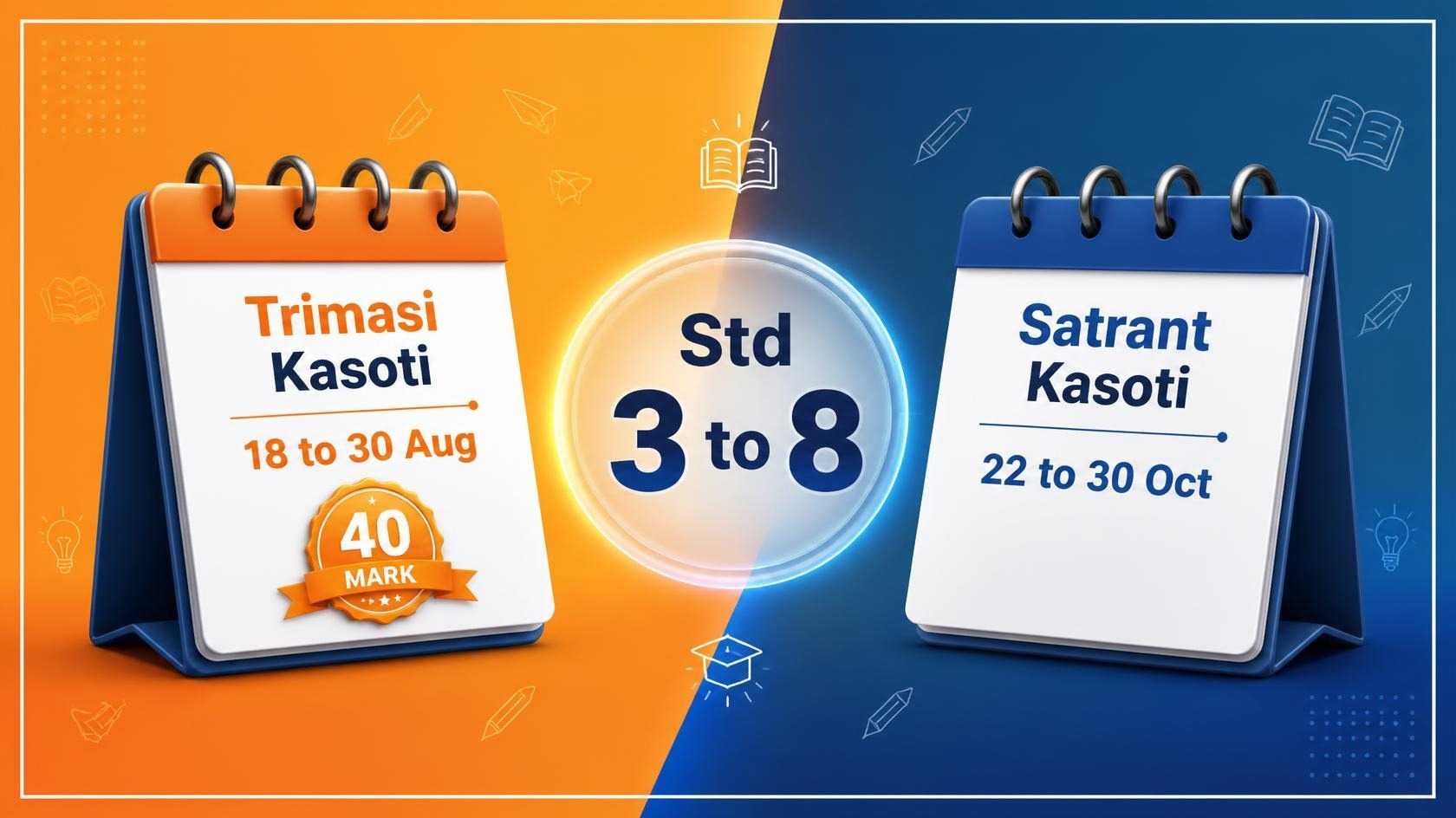
This article provides a complete, SEO-friendly guide covering all essential details about the quarterly and first semester examinations for students, parents, and teachers across Gujarat’s government, granted, and self-financed primary schools.
## 1. Overview: Why the Change?
The Gujarat Education Department formed a specialized committee on March 3 to deliberate on student assessment methods beyond the weekly, fortnightly, and monthly tests. Following widespread protests and representations from teachers and educationists against the *Ekam Kasoti* system introduced in 2019-20, the committee recommended a holistic overhaul.
**Key objectives of the new system:**
– **Reduce examination stress** on over 30 lakh students across more than 32,000 government primary schools
– **Promote conceptual learning** over rote memorization
– **Align with National Education Policy (NEP) 2020** guidelines
– **Enable deeper syllabus coverage** with fewer but more comprehensive assessments
The new system was officially approved through GCERT’s Single File dated 06/08/2025 and implemented from the academic year 2025-26.
—
## 2. Quarterly Examination (*Trimasi Kasoti*) 2025
The Quarterly Examination is the first major assessment milestone under the new system. Here are all the essential details:
### 2.1 Examination Schedule
– **Period:** 18 August 2025 to 30 August 2025
– **Duration:** Each semester will have **one quarterly test of 40 marks per subject** conducted within a 15-day period
– **Flexibility:** Schools can set their own timetable within this 15-day range according to their convenience
– **Syllabus Coverage:** Curriculum taught **up to 15 August 2025**, based on the monthly syllabus allocation available on the GCERT official website
### 2.2 Question Paper Preparation
Teachers are responsible for preparing question papers tailored to their students’ level while adhering to the following guidelines:
– **Competency-based** items must form the foundation of the question paper
– **Question types** must include a mix of:
– Objective (MCQ) questions
– Very short answer questions
– Short answer questions
– Descriptive/Long answer questions
– Various types of process-oriented questions
– **30% of questions** must be based on **National Survey-style Learning Outcome (LO) based MCQ questions**
– **GCERT Question Bank:** A subject-wise and grade-wise question bank will be made available through the Online Attendance Portal (http://schoolattendancegujarat.in/) by 15 August 2025
– **Flexibility:** Teachers may select from the question bank or create similar questions themselves
### 2.3 Implementation Guidelines
| Aspect | Details |
|——–|———|
| **Record Keeping** | All test papers must be kept in school records |
| **Parent Communication** | After checking, answer sheets must be sent to parents for review |
| **Result Inclusion** | Marks will be included in the Formative Assessment (Patrak-A) for semester/year-end results |
| **Inclusive Education** | Special arrangements for differently-abled students as per GCERT guidelines |
| **Monitoring** | CRC-BRC Coordinators, BRP, Education Inspectors, TPEO, SSA District Coordinators, and DIET Lecturers will conduct monitoring during the examination |
### 2.4 Self-Financed Schools
Self-financed primary schools must prepare question papers for **Gujarati (First Language), Mathematics, Science, Social Science, and Environment** subjects according to the state-provided structure and uniform timetable. For remaining subjects, schools may prepare papers at the school level with their own timetable.
—
## 3. First Semester Examination (*Pratham Satrant Kasoti*) 2025
The First Semester Examination is the culminating assessment for Term 1, carrying significant weight in the final academic grading and promotion criteria.
### 3.1 Examination Schedule
– **Period:** 22 October 2026 to 30 October 2026
– **Uniform Timetable:** A state-wide uniform timetable (Annexure-7) has been provided to ensure uniformity across the state
– **Syllabus Coverage:** Curriculum from **June to October** will be covered
### 3.2 Key Guidelines
#### 3.2.1 Centralized Paper Preparation
– **GCERT** will prepare the syllabus framework and subject-wise structure
– **DIETs (District Institutes of Education and Training)** will prepare the actual question papers
– Government and Grant-in-Aid schools must use **uniform question papers for all subjects** following the common timetable
#### 3.2.2 Question Paper Structure
– **30% questions** must be based on National Survey-style **Learning Outcome (LO) based MCQs**
– Question papers must be prepared according to the **prescribed structure (Parirup)** provided by the state
#### 3.2.3 Answer Writing Guidelines
– **Standards 3 and 4:** Students must write answers **in the question paper itself**
– **Standards 5 to 8:** Students must write answers **in separate answer books**
### 3.3 Special Provisions
| Provision | Details |
|———–|———|
| **Maps & Graph Sheets** | For Social Science/Environment (maps) and Mathematics (graph sheets), arrangements must be made by the District/Nagar Primary Education Committee along with the question papers |
| **Inclusive Education** | Guidelines for differently-abled students as per GCERT/Cender/2025/983-1128 dated 09/01/2025 must be followed |
| **Answer Book Evaluation** | Answer book evaluation must be done at the school level |
| **Result Data** | Online result data entry guidelines will be provided by Samagra Shiksha, State Project Director, Gandhinagar |
| **Holiday Adjustments** | If any district declares a local holiday on scheduled exam dates, the holiday must be canceled and exams conducted as per the timetable |
| **Shift Schools** | Schools operating in shifts must also conduct all examinations according to the provided timetable |
—
## 4. Monitoring and Confidentiality
To ensure smooth and fair conduct of examinations, the following measures have been implemented:
### 4.1 Monitoring Mechanism
A dedicated monitoring staff will oversee the examination process, including:
– CRC-BRC Coordinators
– Block Resource Persons (BRP)
– Education Inspectors
– TPEOs
– SSA District Coordinators
– DIET Lecturers
### 4.2 Confidentiality
Strict confidentiality must be maintained throughout the entire examination process. Question papers must be distributed only on the scheduled dates.
—
## 5. Model Question Papers and Preparation Resources
GCERT has released **model question papers** for all subjects to help students and teachers prepare effectively.
### Available Subjects for Classes 3 to 8:
– Gujarati
– Mathematics
– English
– Hindi
– Science (Classes 6 to 8)
– Social Science (Classes 6 to 8)
– Sanskrit (Classes 6 to 8)
These model papers are designed using the official question bank, providing students with a clear understanding of the **exam pattern** and helping teachers evaluate progress effectively.
—
## 6. Preparation Tips for Students
With the shift from frequent unit tests to quarterly and semester examinations, students need to adopt a more strategic approach to their studies:
### 6.1 Consistent Study Routine
Without weekly tests, self-discipline becomes crucial. Students should:
– **Study regularly** at home rather than cramming at the last minute
– **Allocate specific time** each day for each subject
– **Review previous lessons** alongside current topics
### 6.2 Focus on Textbooks
All questions are strictly based on the **GCERT-prescribed curriculum**. Students should:
– **Thoroughly read** the Gujarat State Board textbooks
– **Pay attention** to examples, exercises, and summary points
– **Practice all** in-text and end-of-chapter questions
### 6.3 Practice Writing Skills
Since semester papers include descriptive and long-answer questions:
– Practice **structured answers** with clear introduction, body, and conclusion
– Work on **handwriting and presentation**
– **Time yourself** while practicing to manage exam time effectively
### 6.4 Use Model Papers
– **Download GCERT model papers** available on the official website
– **Solve previous years’ question papers** (where available)
– **Familiarize yourself** with the mix of objective, short answer, and descriptive questions
### 6.5 Focus on Learning Outcomes
With 30% of questions being **LO-based MCQs**:
– **Understand concepts** rather than memorizing facts
– **Apply knowledge** to new situations
– **Practice National Survey-style** questions
—
## 7. Important Points for Parents
Parents play a crucial role in supporting their children through this transition:
### 7.1 Stay Informed
– Check the **official notice board** at your child’s school
– Visit the **GCERT official website** (www.gcert.gujarat.gov.in) for updates
– Follow the **Online Attendance Portal** (http://schoolattendancegujarat.in/) for schedules
### 7.2 Support Without Pressure
– **Encourage regular study** habits
– **Discuss what they learned** in school each day
– **Avoid creating anxiety** about examinations
– **Celebrate effort** and improvement, not just marks
### 7.3 Health and Well-being
– Ensure your child gets **adequate sleep** during exam periods
– Provide **nutritious meals** and hydration
– Allow **regular breaks** during study sessions
– **Monitor screen time** and ensure physical activity
—
## 8. Frequently Asked Questions (FAQs)
### Q1: Why were unit tests (Ekam Kasoti) replaced?
**A:** Following recommendations from the 360-degree evaluation committee, the unit test system was replaced to reduce student stress and enable more comprehensive, meaningful assessment of learning outcomes.
### Q2: When is the quarterly exam scheduled?
**A:** The quarterly exam will be held from **18 August to 30 August 2025**.
### Q3: When is the first semester exam scheduled?
**A:** The first semester exam will be held from **22 October to 30 October 2026**.
### Q4: How many marks is each quarterly exam?
**A:** Each subject carries **40 marks** in the quarterly examination.
### Q5: Will the exam marks affect the final result?
**A:** Yes, marks will be included in the **Formative Assessment (Patrak-A)** for semester and year-end results.
### Q6: Where can I find model question papers?
**A:** Model question papers are available on the **GCERT official website** and through the Online Attendance Portal.
### Q7: What provisions exist for differently-abled students?
**A:** Special arrangements must be made as per GCERT guidelines (GCERT/Cender/2025/983-1128 dated 09/01/2025).
—
## 9. Summary Comparison Table
| Feature | Quarterly Exam (Trimasi) | First Semester Exam (Satrant) |
|———|————————–|——————————-|
| **When** | 18–30 August 2025 | 22–30 October 2026 |
| **Marks** | 40 marks per subject | As per prescribed structure |
| **Syllabus** | Up to 15 August | June to October |
| **Paper Preparation** | By teachers (school level) | By DIETs (centralized) |
| **Question Types** | Objective, Short, Descriptive + 30% LO-based MCQs | Objective, Short, Descriptive + 30% LO-based MCQs |
| **Result Inclusion** | Formative Assessment (Patrak-A) | Formative Assessment (Patrak-A) |
| **Answer Writing** | Std 3-4: in paper; Std 5-8: in answer book | Std 3-4: in paper; Std 5-8: in answer book |
👉Pdf daunload કરવા માટે અહીં ક્લિક કરો
## 10. Conclusion
The introduction of the quarterly and semester examination system for Standards 3 to 8 marks a **significant milestone** in Gujarat’s primary education landscape for the academic year 2025-26. This student-friendly reform, implemented by GCERT following the 360-degree evaluation committee’s recommendations, aims to foster **deep learning**, **conceptual clarity**, and **holistic development**.
For parents and students, this transition requires **adaptation**—moving from frequent memorization-based tests to fewer but more comprehensive assessments. For teachers, it demands **innovative approaches** to question paper preparation, focusing on learning outcomes and competency-based evaluation.
By understanding the new system thoroughly and preparing strategically, students can excel in these examinations while developing lifelong learning skills. For the most accurate and school-specific information, always refer to the **official GCERT website** and your child’s school administration.