Solar Rooftop Scheme 2026: Subsidy, Eligibility, Benefits & Online Apply
Meta Description: Solar Rooftop Scheme 2026 complete guide. Check PM Surya Ghar Yojana subsidy, eligibility, benefits, documents and online application process.
Focus Keyword: Solar Rooftop Scheme 2026
Related Keywords: PM Surya Ghar Muft Bijli Yojana, Solar Panel Subsidy in India, Rooftop Solar Subsidy, PM Surya Ghar Online Apply, Free Electricity Scheme, Solar Panel Installation.
Introduction to Solar Rooftop Scheme 2026
The Solar Rooftop Scheme is an important initiative by the Government of India to encourage households to generate electricity using solar energy. Under the PM Surya Ghar: Muft Bijli Yojana, eligible residential electricity consumers can receive financial assistance from the government to install rooftop solar panels on their houses.
The scheme was launched in February 2024 with a total financial outlay of ₹75,021 crore. Its primary objective is to help one crore households adopt rooftop solar power and reduce their dependence on conventional electricity sources. The scheme aims to provide households with the opportunity to receive up to 300 units of electricity per month through solar generation, depending on system capacity and actual electricity production. Official government information.
Installing solar panels can help families reduce their monthly electricity bills, use clean energy and potentially export surplus electricity to the grid, subject to applicable state electricity regulations.
In this article, you will learn about the Solar Rooftop Scheme 2026, subsidy amounts, eligibility criteria, required documents, online registration, installation procedures and important points to consider before applying.
What Is the PM Surya Ghar Muft Bijli Yojana?
The PM Surya Ghar: Muft Bijli Yojana is a centrally sponsored initiative implemented by the Ministry of New and Renewable Energy (MNRE).
Under the scheme, eligible residential consumers can apply for financial assistance to install a grid-connected rooftop solar system. The government provides a subsidy based on the eligible installed solar capacity and applicable scheme guidelines.
The main objective is to make solar energy more accessible and affordable for Indian households.
Key Highlights of the Solar Rooftop Scheme
- Scheme name: PM Surya Ghar: Muft Bijli Yojana
- Launched: February 2024
- Implementing ministry: Ministry of New and Renewable Energy
- Total scheme outlay: ₹75,021 crore
- Target: One crore residential households
- Maximum standard central subsidy: ₹78,000 for eligible residential systems
- Main benefit: Reduced electricity bills through rooftop solar generation
- Application mode: Online
- Official website: https://pmsuryaghar.gov.in
The scheme is intended primarily for residential electricity consumers with eligible grid-connected electricity connections.
Solar Rooftop Scheme Subsidy Amount 2026
One of the most important features of the scheme is the central financial assistance available to eligible households.
For residential consumers in most states, the standard subsidy structure is as follows:
| Solar System Capacity | Government Subsidy |
|---|---|
| 1 kW | ₹30,000 |
| 2 kW | ₹60,000 |
| 3 kW | ₹78,000 |
| Above 3 kW | Maximum ₹78,000 |
The subsidy is calculated according to the applicable central financial assistance rules. The figures above reflect the standard subsidy structure announced for the scheme. The actual eligible amount is subject to the official portal’s rules and approval.
For systems up to 2 kW, the subsidy is generally ₹30,000 per kW. For the additional capacity between 2 kW and 3 kW, the assistance is ₹18,000 per additional kW. No additional standard central subsidy is provided for capacity beyond 3 kW.
Special Subsidy Rates for Certain States
Residents of certain special-category states and Union Territories may qualify for higher subsidy rates under applicable guidelines.
Therefore, applicants should check the subsidy applicable to their state on the official PM Surya Ghar portal before purchasing or installing solar equipment.
Example of Solar Subsidy Calculation
Suppose a household installs a 3 kW rooftop solar system.
- Approximate installation cost: Depends on the vendor, equipment and location.
- Eligible central subsidy: Up to ₹78,000.
- Effective cost: Installation cost minus the approved subsidy.
For example, if the eligible installation costs ₹1,80,000 and the approved subsidy is ₹78,000, the remaining cost would be ₹1,02,000.
This is only an illustrative calculation, not an official installation quotation. Actual costs vary by location, equipment quality, installation requirements and vendor pricing.
Eligibility Criteria for Solar Rooftop Scheme 2026
Before applying, households should check whether they meet the scheme’s eligibility requirements.
The main eligibility conditions are:
- The applicant must be an eligible residential electricity consumer in India.
- The household must have a valid electricity connection from the local electricity distribution company, commonly known as DISCOM.
- The rooftop solar system must meet the technical and other requirements specified under the scheme.
- The applicant must follow the official registration, feasibility approval and installation procedure.
- The solar installation must use equipment meeting the applicable government requirements, including domestic content requirements where prescribed.
- The applicant must install the system through an eligible vendor listed on the official portal.
- The applicant must complete the required inspection, commissioning and subsidy claim formalities.
Important: Commercial and industrial electricity connections should not assume that they qualify for the same residential subsidy. Applicants should verify the rules applicable to their consumer category.
Benefits of the Solar Rooftop Scheme
The scheme offers several potential benefits to households interested in generating their own electricity.
1. Government Subsidy
Eligible households can receive central financial assistance to reduce the upfront cost of installing rooftop solar panels.
For eligible systems of 3 kW or more, the standard central subsidy is capped at ₹78,000 in most states.
2. Lower Electricity Bills
Solar panels generate electricity from sunlight. When the household uses this electricity directly, it can reduce the amount of power purchased from the electricity grid.
The actual savings depend on monthly consumption, solar generation, tariff rates, system size and applicable billing arrangements.
3. Potential Access to Up to 300 Units of Solar Electricity
The scheme aims to support households in meeting their electricity needs through rooftop solar generation, with a target of up to 300 units per month.
However, this does not mean every beneficiary automatically receives 300 free units regardless of system performance. Actual generation varies according to sunlight, weather, shading, system capacity and other factors.
4. Environmentally Friendly Energy
Solar power generates electricity without directly burning fossil fuels during operation. Greater adoption can help reduce dependence on conventional electricity generation and lower associated emissions.
5. Opportunity to Export Surplus Electricity
Where permitted by the applicable state regulations and the approved grid-connection arrangement, surplus solar electricity may be exported to the grid.
Any compensation or credit for exported electricity depends on the relevant state policy, DISCOM rules and metering arrangement.
6. Long-Term Electricity Savings
Solar panels can provide electricity for many years when properly installed and maintained. Although the initial investment can be significant, households may recover part of their investment through reduced electricity bills over time.
Documents Required for Solar Rooftop Scheme
Applicants should keep the following information and documents ready before beginning the online application.
- Recent electricity bill or electricity consumer number
- Registered mobile number
- Email address
- Bank account details
- Bank account proof or cancelled cheque, where required
- Identity and address details, if requested by the portal
- Additional documents required by the DISCOM or under the current application process
The exact requirements may vary depending on the applicant’s situation and the stage of the application.
Applicants should enter accurate bank details and ensure that the account information satisfies the scheme’s payment requirements. Any name or account mismatch could delay subsidy processing.
How to Apply Online for Solar Rooftop Scheme 2026
The application process is conducted through the official PM Surya Ghar National Portal.
Official application website: https://pmsuryaghar.gov.in
Follow these steps to apply.
Step 1: Visit the Official Website
Open the official PM Surya Ghar portal in your mobile browser or on a computer.
Always verify that you are using the official government website before entering personal or electricity account information.
Step 2: Register as a Consumer
Select the consumer registration option available on the portal.
You will generally need to provide:
- Your state
- Your electricity distribution company (DISCOM)
- Your electricity consumer account number
- Your registered mobile number
- Your email address, where requested
Enter the information carefully and complete the verification process.
Step 3: Log In to Your Account
After registration, log in using the credentials or verification method provided by the portal.
Open the rooftop solar application section and follow the instructions displayed on the screen.
Step 4: Submit the Rooftop Solar Application
Complete the application form with the requested consumer details and system information.
Submit the application and wait for the required technical feasibility approval from your electricity distribution company.
Do not assume that registration alone guarantees approval or payment of the subsidy.
Step 5: Select an Eligible Solar Vendor
Once the necessary approval is received, select an eligible vendor listed on the official portal.
Compare quotations, equipment specifications, warranties, installation services and after-sales support before making a decision.
Ask the vendor to explain the total installation price and the items included in the quotation.
Step 6: Install the Solar System
The selected vendor will install the rooftop solar system according to the approved requirements.
The installation may include solar panels, an inverter, mounting structures, wiring, safety equipment and other necessary components.
Ensure that the installation complies with the applicable technical and safety standards.
Step 7: Complete Metering and Inspection
After installation, submit the required system details through the portal.
Follow the instructions for installation verification, net-metering arrangements where applicable, and commissioning by the DISCOM.
The subsidy process generally requires successful installation and verification in accordance with the scheme guidelines.
Step 8: Submit Bank Details for Subsidy
After the required commissioning process is completed, provide or confirm the bank account information requested on the portal.
Submit any additional documents required for the claim.
The authorities will process the eligible subsidy according to the applicable verification and payment procedures.
Step 9: Check Your Application Status
Log in to the official portal to track the application and subsidy status.
If there is a delay, check whether any documents, technical approvals or bank verification steps remain incomplete.
For the latest application instructions, visit the official PM Surya Ghar website.
How Much Electricity Can a Rooftop Solar System Generate?
The amount of electricity produced by solar panels depends on several factors, including location, sunlight, weather, roof direction, shading and equipment efficiency.
The following table provides an illustrative guide to system selection, not a guaranteed generation estimate.
| Monthly Electricity Consumption | Indicative System Capacity |
|---|---|
| 0–150 units | 1–2 kW |
| 150–300 units | 2–3 kW |
| Above 300 units | 3 kW or more |
A qualified solar installer can assess the roof and estimate the appropriate system capacity based on your electricity consumption.
Households should not select a larger system solely to obtain a subsidy. The standard central subsidy is capped at the eligible 3 kW level, so a larger system does not automatically receive additional central assistance.
How to Check Solar Rooftop Scheme Application Status
Applicants can generally check their application progress through the official PM Surya Ghar portal.
Follow these steps:
- Visit https://pmsuryaghar.gov.in.
- Log in to your registered account.
- Open the relevant application or status section.
- Review the latest status and any pending requirements.
- Follow the instructions if additional information or verification is requested.
Keep your consumer number and registration details available while checking the application.
Important Things to Check Before Installing Solar Panels
Before investing in a rooftop solar system, consider the following points.
Roof suitability: Ensure that your roof has sufficient usable space and can support the installation.
Vendor selection: Choose an eligible vendor and verify the details on the official portal.
Quotation: Ask for a written quotation covering equipment, installation, warranties and any additional charges.
System capacity: Match the proposed system to your electricity consumption and available roof space.
Metering rules: Confirm the applicable net-metering or other approved billing arrangements with your DISCOM.
Subsidy approval: Do not assume that buying panels independently will automatically qualify you for government assistance.
Maintenance: Keep the panels clean according to the manufacturer’s instructions and arrange periodic inspections when necessary.
Safety: Ensure proper earthing, protection devices, wiring and installation by qualified professionals.
Is the Solar Rooftop Scheme Available in Gujarat?
Eligible residential electricity consumers in Gujarat can explore the PM Surya Ghar: Muft Bijli Yojana through the national portal.
The applicable DISCOM, technical feasibility, vendor availability, subsidy rules and metering arrangements should be verified during the application process.
Residents should register through the official portal and follow the instructions relevant to their electricity connection.
For households in Gujarat and other states, the official portal is the preferred starting point for checking current eligibility and application requirements.
Frequently Asked Questions (FAQs)
1. What is the Solar Rooftop Scheme 2026?
The Solar Rooftop Scheme generally refers to government support for installing rooftop solar panels. The main central residential initiative is the PM Surya Ghar: Muft Bijli Yojana.
2. What is the maximum subsidy under PM Surya Ghar?
The standard central subsidy for eligible residential consumers is up to ₹78,000 in most states, subject to the applicable scheme rules.
3. Can I get a subsidy for a 1 kW solar system?
Yes. An eligible residential consumer installing a qualifying 1 kW system can generally receive a central subsidy of ₹30,000 under the standard structure.
4. Is electricity completely free under this scheme?
Not necessarily. Solar generation can significantly reduce electricity bills, and the scheme aims to support up to 300 units of monthly solar electricity. Actual benefits depend on generation, consumption, tariffs and billing arrangements.
5. How can I apply for the scheme?
Visit https://pmsuryaghar.gov.in, register using your electricity consumer details, submit the application, obtain the required approval and follow the official installation and commissioning process.
6. Is Aadhaar mandatory for the application?
Applicants should follow the identity verification and documentation instructions currently displayed on the official portal. Requirements can change, so verify the latest instructions before submitting the application.
7. How is the subsidy paid?
For the standard national portal process, the subsidy is transferred to the eligible beneficiary’s bank account after the required installation, verification and commissioning steps are completed.
8. Can tenants apply for rooftop solar subsidy?
Eligibility depends on the electricity connection, permission to install the system and the applicable scheme conditions. Tenants should obtain the necessary property owner’s consent and verify their eligibility with the relevant DISCOM before applying.
9. Can I install a solar system larger than 3 kW?
Yes, subject to technical approval and applicable regulations. However, the standard central residential subsidy is capped at the eligible 3 kW level.
10. What is the official website for the Solar Rooftop Scheme?
The official portal for PM Surya Ghar: Muft Bijli Yojana is https://pmsuryaghar.gov.in.
Conclusion
The Solar Rooftop Scheme 2026 provides an opportunity for eligible Indian households to reduce the initial cost of installing solar panels through government financial assistance. Under the PM Surya Ghar: Muft Bijli Yojana, eligible residential consumers can receive a standard central subsidy of up to ₹78,000 in most states.
By generating electricity at home, families may reduce their dependence on grid electricity and benefit from long-term savings. However, actual savings and electricity generation depend on system capacity, weather, consumption and local electricity regulations.
Before applying, check the eligibility conditions, select an eligible vendor and follow the official application, installation and verification process.
Apply online: https://pmsuryaghar.gov.in
Disclaimer: This article is for general informational purposes. Subsidy amounts, eligibility, technical requirements and application procedures may change. Always verify the latest details through the Ministry of New and Renewable Energy and the official PM Surya Ghar portal before making a financial commitment.
Suggested Internal Links
Add relevant links from your website to these articles if they are available:
- Government Schemes in India 2026
- How to Apply for Government Subsidies Online
Suggested External Links
- PM Surya Ghar Official Portal: https://pmsuryaghar.gov.in
- Ministry of New and Renewable Energy: https://mnre.gov.in/
Featured Image Suggestion
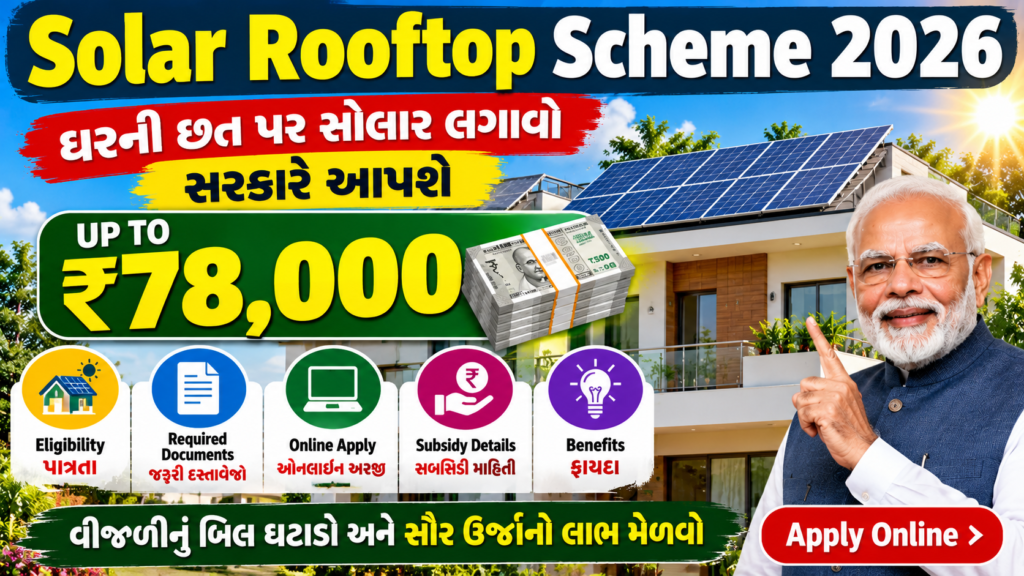
Create a 1200 × 675 px featured image showing a modern Indian house with rooftop solar panels, sunlight, a clean blue sky and a small electricity savings concept. Suggested image text: “Solar Rooftop Scheme 2026 – Subsidy Up to ₹78,000”.
Important links
Official Website માટે અહીં ક્લિક કરો
ઓનલાઈન અરજી કરવા માટે અહીં ક્લિક કરો
ગુજરાતીમાં માહિતી માટે અહીં ક્લિક કરો
SEO Publishing Checklist
- Use the focus keyword in the SEO title, introduction and at least one subheading.
- Keep the URL short, for example:
solar-rooftop-scheme-2026 - Add the meta description in your SEO plugin.
- Use a compressed, descriptive featured image with suitable alt text.
- Link to official government sources for trust and accuracy.
- Review the article periodically when official subsidy rules change.